
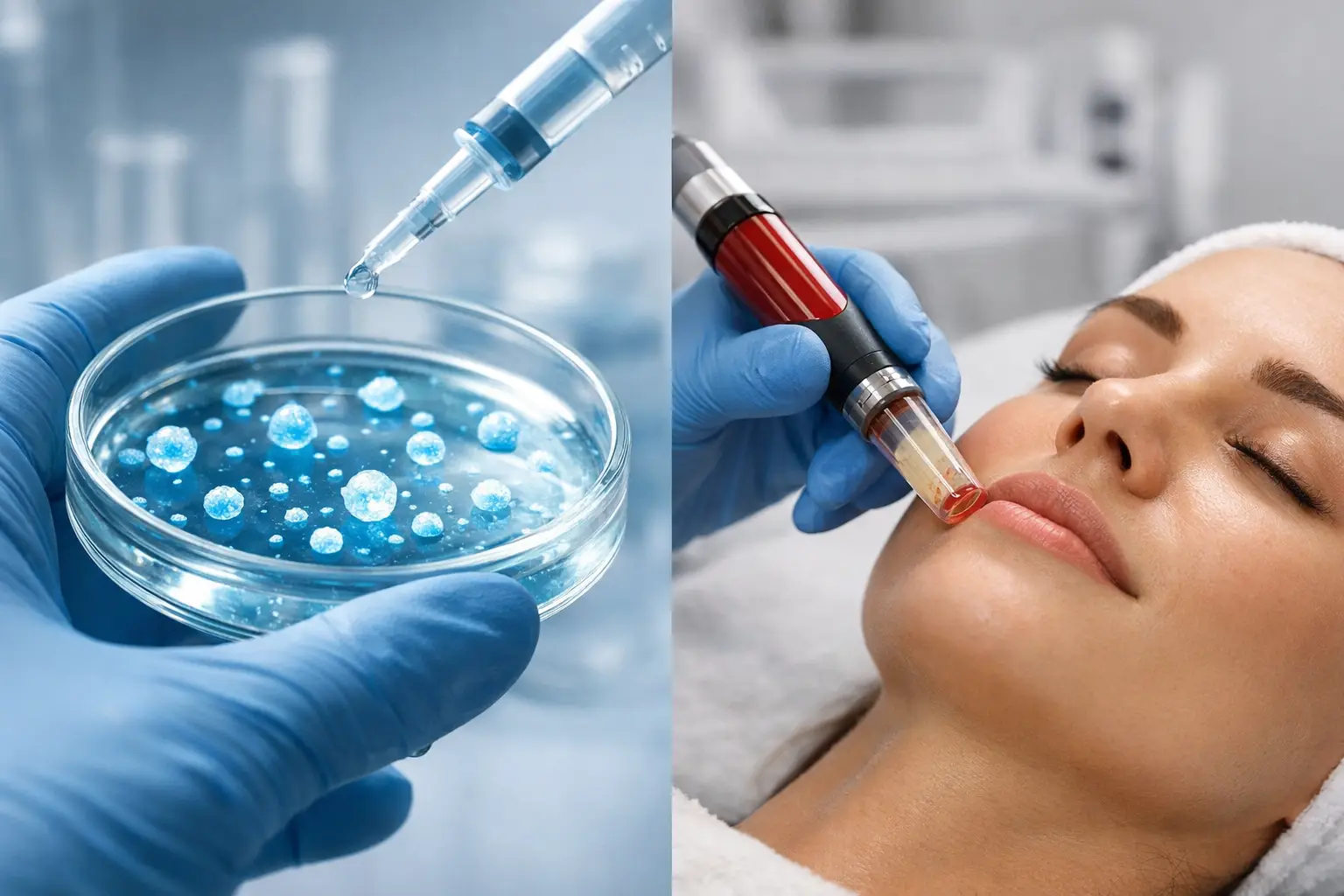
Exosomes vs PRP Microneedling Treatments
A client may come in asking for the newest skin treatment they saw online, but the right choice is rarely about what is trending. When comparing exosomes vs prp microneedling, the more useful question is which option fits your skin history, goals, tolerance for downtime, and comfort level with the treatment materials being used.
Both treatments are often discussed as ways to support a fresher, smoother, more refined complexion. They are not interchangeable. PRP microneedling uses a concentrated portion of your own blood, while exosome-based treatments use products derived from laboratory-processed cells. The difference affects safety considerations, treatment planning, cost, and the level of clinical certainty behind the service.
How Microneedling Supports Skin Renewal
Microneedling uses a controlled device with fine needles to create precise microchannels in the skin. Those controlled channels trigger the skin’s natural repair response and can support collagen and elastin production over time. It is commonly selected to improve the appearance of fine lines, enlarged pores, uneven texture, acne scarring, and early signs of laxity.
Technique matters. Needle depth, speed, number of passes, skin preparation, and post-treatment care should be adjusted to the treatment area and your individual skin condition. More aggressive is not automatically better. Proper treatment should create an intentional response without unnecessary trauma, prolonged inflammation, or disruption to the skin barrier.
Microneedling can be performed as a stand-alone service or paired with selected topical products. PRP and exosome products are two very different add-ons that may be used during or immediately after treatment, when the skin is more receptive to what is applied to its surface.
PRP Microneedling: Using Your Own Biology
PRP stands for platelet-rich plasma. A trained provider draws a small amount of your blood and processes it in a centrifuge to separate and concentrate the platelet-rich portion. That plasma may then be applied topically during microneedling or used through other provider-directed techniques, depending on the treatment plan.
Platelets contain signaling proteins and growth factors involved in the body’s normal healing processes. Because PRP comes from your own blood, it is considered autologous. For many clients, that is a meaningful advantage. There is no donor-derived product, and the risk of an immune reaction to the PRP itself is generally lower than with a biologic product from another source.
PRP microneedling is often a strong fit for clients who want a biologically based skin-rejuvenation option with a familiar treatment process. It can be especially appropriate for concerns such as dullness, crepey texture, fine lines, and acne scar support. Results are gradual rather than overnight. Most skin-rebuilding plans require a series of treatments, followed by maintenance based on age, sun exposure, skincare habits, and the condition being addressed.
The trade-off is that PRP quality can vary from person to person. Hydration, overall health, medications, platelet count, and the processing protocol can all affect the final preparation. A responsible consultation should include questions about blood-thinning medications, active skin infections, medical conditions, and whether you are a suitable candidate for a blood draw.
Exosome Microneedling: What the Term Actually Means
Exosomes are extremely small particles released by cells. They are not stem cells themselves. They can carry proteins, lipids, and genetic signaling material, which is why they have attracted attention in regenerative medicine and aesthetics.
In an aesthetic setting, an exosome product is typically applied after microneedling as a topical treatment. Marketing often emphasizes faster recovery, reduced redness, and more dramatic rejuvenation. Some clients are drawn to the idea because it sounds advanced, and because exosomes are often positioned as a next-generation alternative to PRP.
That language requires careful context. Exosome products can vary significantly in source material, processing, concentration, storage requirements, purity testing, and intended use. In the United States, many exosome products marketed for aesthetic use are not FDA-approved to treat or prevent a medical condition. The fact that a product is available does not mean every claim made around it is supported by the same level of evidence.
This does not mean every exosome treatment is automatically inappropriate. It does mean clients should be selective about the provider, product documentation, sanitation standards, and claims being made. A qualified provider should be able to explain what is being applied to your skin, how it is stored and handled, whether it is intended for topical use, and what realistic outcomes to expect.
Exosomes vs PRP Microneedling: Key Differences
The most direct difference is the material used after or alongside microneedling. PRP is created from your own blood during your appointment. Exosomes are an externally sourced, commercially prepared product.
PRP has the advantage of being personalized to your body and prepared under direct clinical protocols. It also has a longer history of use in aesthetic and medical settings. Exosome treatments may appeal to clients who prefer not to have blood drawn or are interested in a product designed for post-procedure skin support. However, the quality and regulatory status of exosome products demand more scrutiny.
Cost is another practical consideration. PRP microneedling includes the blood draw, processing equipment, and clinical preparation time. Exosome treatments can also be premium-priced because of product cost and handling requirements. Neither option should be chosen simply because it carries a higher price tag. The better investment is the treatment that addresses your actual concern with an appropriate protocol and a provider who does not overpromise.
Recovery can be similar because microneedling itself is responsible for much of the initial redness and sensitivity. Many clients experience redness, warmth, tightness, and mild swelling for one to three days. Deeper treatments or more reactive skin may require longer recovery. Whether PRP or an exosome product is used, you should still follow aftercare carefully, avoid excessive heat and sun exposure, skip irritating active skincare ingredients as directed, and wear broad-spectrum sunscreen.
Which Treatment Is Better for Your Skin?
For many clients, PRP microneedling is the more straightforward choice when they want an advanced treatment that uses their own platelet-rich plasma. It is particularly appealing for clients who value autologous treatment materials and prefer a well-established process.
Exosome microneedling may be considered when a provider uses a carefully vetted topical product and can clearly discuss its origin, handling, limitations, and expected benefits. It should never be presented as a miracle treatment, a replacement for good skincare, or a guarantee of dramatic skin transformation.
Neither service is appropriate when you have an active acne flare, open lesions, a skin infection, or certain medical conditions that interfere with healing. Pregnancy, a history of abnormal scarring, recent isotretinoin use, autoimmune concerns, and medications that affect clotting or immunity should be discussed before scheduling. Clients with melasma or a tendency toward post-inflammatory hyperpigmentation also need a conservative, customized approach to reduce the risk of unwanted discoloration.
What a Professional Consultation Should Cover
An informed consultation should go beyond selecting PRP or exosomes. Your provider should evaluate your skin quality, pigmentation patterns, acne history, scarring, sensitivity, current skincare routine, and previous aesthetic treatments. Photos may be recommended to track changes objectively over a series.
You should also be clear about your goal. Are you trying to soften fine lines around the mouth, improve makeup texture, address old acne scars, or support overall collagen production? A focused goal helps determine whether microneedling is the best first step or whether another service, such as RF microneedling, a peel, facial treatment, injectable service, or a combined plan would be more effective.
At Vintage Lashes and Beauty Services, Advanced Microneedling PRP is approached as a precision skin-renewal service, not a one-size-fits-all add-on. Proper preparation, controlled technique, clean treatment standards, and disciplined aftercare protect both your skin and the value of your investment.
The best treatment is the one that makes sense for your skin, your medical history, and your long-term maintenance plan. Ask direct questions, choose a provider who welcomes them, and give your skin the consistency it needs to show meaningful improvement.