
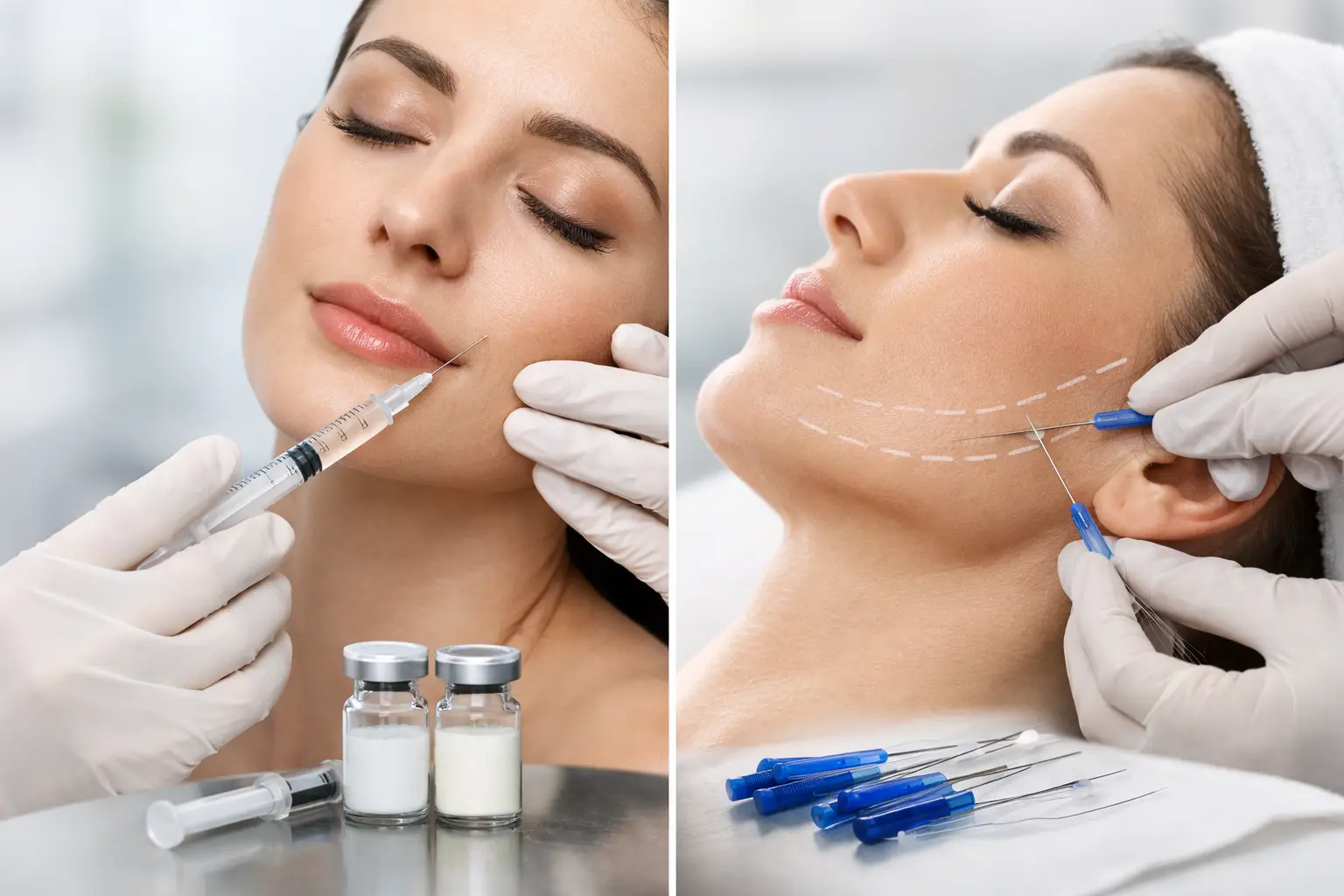
Sculptra or PDO Threads: Which Fits Best?
If your mirror is showing early sagging, softer jawline definition, or skin that looks less supported than it used to, the question usually becomes sculptra or pdo threads – not whether you want treatment, but which one actually matches your face and your goals. These are not interchangeable services, even though both are used to improve facial support and collagen production. The right choice depends on what is changing, how quickly you want to see it, and whether you need lift, volume support, or both.
At a glance, Sculptra is a biostimulator injectable. It works by encouraging your body to produce collagen over time. PDO threads are dissolvable sutures placed under the skin to create a more immediate repositioning effect while also stimulating collagen as they dissolve. Both can be excellent treatments in the right hands. Both can also disappoint when chosen for the wrong concern.
Sculptra or PDO threads: what is the real difference?
The simplest way to think about it is this: Sculptra builds. Threads support and reposition. That difference matters because aging does not show up the same way on every face.
Sculptra is often a better fit when the face looks deflated, hollow, or generally less firm. It is commonly used to restore structure in areas where collagen loss has made the skin and deeper tissues look thinner or less resilient. The improvement is gradual, which appeals to clients who want natural-looking change without an obvious overnight shift.
PDO threads are often chosen when the issue is more about mild to moderate sagging. If the cheeks are starting to descend, the jowl area is softening, or the lower face needs a more lifted look, threads may offer a more direct answer. They can create visible support sooner than Sculptra, although the result still depends heavily on skin quality, anatomy, and realistic expectations.
Neither treatment should be sold as a replacement for surgery when surgery is actually what a patient needs. A strong provider will be honest about that. Non-surgical options can do a lot, but precision matters and so does restraint.
How Sculptra works
Sculptra is made with poly-L-lactic acid, a collagen stimulator that is injected beneath the skin. Unlike traditional filler, it does not primarily work by placing volume that you see immediately and keep as-is. Instead, it creates a controlled response that stimulates collagen production over the following weeks and months.
That makes Sculptra especially useful for clients who want a gradual improvement in facial structure and skin support. Temples, cheeks, smile lines, jawline transitions, and even certain body areas can benefit, depending on the treatment plan. The effect tends to look more like you at your best rather than you with something added.
There is patience involved. Most clients need a series of treatments, and the final result develops over time. If someone wants instant correction for an event next week, Sculptra is usually not the right standalone answer. If someone wants long-term collagen support and is willing to build strategically, it can be a very strong option.
Best candidates for Sculptra
Sculptra often suits clients with volume loss, age-related hollowing, crepey texture related to collagen decline, or a face that simply looks less supported than it used to. It is also helpful for those who want a natural progression instead of a dramatic one-time change.
It may be less ideal for someone with very thin skin in certain areas, significant skin laxity that really needs repositioning, or expectations centered on immediate lift. In those cases, another treatment or a combination approach may be more appropriate.
How PDO threads work
PDO threads are absorbable sutures placed beneath the skin using fine cannulas or needles, depending on the thread type and treatment area. Some are smooth threads designed mainly for collagen stimulation. Others have barbs or cones that are intended to grasp tissue and create lift.
The appeal of threads is that they can create visible structural support relatively quickly. In the right candidate, they can improve the appearance of the midface, jawline, marionette region, or neck by repositioning tissue and encouraging collagen formation as the threads dissolve.
This is not a casual treatment. Technique, vector placement, tissue quality, and patient selection all matter. Threads can be extremely effective for mild to moderate sagging, but they are not a magic fix for heavy tissue, severe laxity, or skin that lacks enough integrity to hold the result well.
Best candidates for PDO threads
PDO threads are often best for clients who still have decent skin quality but are beginning to notice descent in the lower face or cheeks. They can be ideal for someone who wants more definition and lift without surgery and understands that the result has limits.
They may not be the best answer for a face that primarily needs volume restoration. A thread can lift tissue, but it cannot replace foundational support that has been lost over time. If the face is both deflated and sagging, using threads alone may leave the result looking under-corrected.
Which lasts longer?
This is where the answer depends on what you mean by lasting. Sculptra stimulates your own collagen, so the improvement can be long-lasting when a proper treatment series is completed and maintenance is done appropriately. PDO threads dissolve over time, but the collagen they stimulate can help extend the visible benefit beyond the life of the actual thread.
That said, longevity is affected by age, skin thickness, facial movement, sun exposure, metabolism, and how much correction was needed to begin with. In practice, many clients think of Sculptra as the slower-building, longer-horizon option and threads as the more immediate structural option that may require maintenance sooner.
Downtime, recovery, and appointment planning
Sculptra and threads both require aftercare, but the recovery experience is different.
After Sculptra, swelling, tenderness, and bruising are possible. Because it is an injectable treatment, most clients return to normal activity relatively quickly, but they still need to follow post-care instructions closely. Massage protocols may be recommended depending on the provider’s approach and the treatment area.
Threads usually come with a more restrictive short-term recovery period. Bruising, swelling, tenderness, puckering, and a feeling of tightness can happen. Clients need to be careful with facial movement, sleeping position, workouts, and pressure on the treated areas during the early healing phase. This is one reason treatment timing matters. If you have a major event, you should not wait until the last minute.
For clients with demanding schedules, compliance matters just as much as convenience. A treatment is only as good as the healing that follows it.
Can Sculptra and PDO threads be combined?
Yes, and in many cases that is where the best non-surgical outcome happens. If the face has both volume depletion and tissue descent, choosing between sculptra or pdo threads may be the wrong question. You may need both, staged correctly.
For example, a patient with midface flattening and early jowling may benefit from collagen-building support with Sculptra and structural lifting with threads. The sequence and spacing matter. You do not stack treatments carelessly. You build a plan around tissue health, healing, and the result you want six months from now, not just next week.
This is why consultation quality matters. A thorough assessment should look at facial balance, skin quality, asymmetry, degree of laxity, and how aggressive or conservative the treatment should be. A polished result rarely comes from chasing one isolated problem.
Sculptra or PDO threads: how to choose well
If your main concern is hollowing, thinning skin support, or age-related deflation, Sculptra is often the stronger choice. If your main concern is mild sagging, jawline softening, or a descent-related issue that would benefit from repositioning, PDO threads may be more appropriate.
If you want immediate correction, threads usually have the advantage. If you want gradual collagen restoration with a subtle evolution, Sculptra often fits better. If you want the best overall facial support and you are a candidate for both, combining them may produce a more complete result than either treatment alone.
The biggest mistake is choosing based on trend language instead of anatomy. The second biggest mistake is assuming every provider approaches these treatments with the same level of precision. In a proper medspa setting, treatment planning should be conservative, customized, and grounded in safety. That includes reviewing your medical history, skin condition, timing, expectations, and aftercare responsibilities before anything is placed.
At Vintage Lashes and Beauty Services, that level of procedural clarity matters because results are only part of the standard. Technique, sanitation, patient selection, and aftercare discipline are what protect those results.
The best treatment is not the one that sounds more advanced. It is the one that solves the problem your face is actually presenting, on a timeline and maintenance plan you can realistically follow.